What Service Charges Can (and Can't) Legally Be Spent On
What service charges can and can't legally be spent on for UK residential blocks: the three tests, what's typically recoverable, and where directors get caught out.

This article is general information, not legal or financial advice. Always take qualified professional advice for your own building.
The quote is on the kitchen table. The work needs doing, nobody in the block disagrees about that, and you are the person who has to decide whether the building's money pays for it. You are not an accountant. You are not a solicitor. You took the director role because somebody had to, and now you are sitting up at eleven o'clock wondering whether one decision, one signature is going to come back to bite you.
So, let's help you work through where you stand. A sensible spend and a recoverable spend are two different tests, and only one of the two matters legally.
The Short Version
Service charges can only be spent on costs the lease actually allows.
A cost is recoverable, meaning the lease allows you to charge leaseholders for it, only where the cost is for the building or common parts, also falls within the service charge wording, and is reasonable in amount and reasonably incurred. Fail any one of the three and the cost is not recoverable, however sensible the spending was.
Start from these:
- The lease is the source of truth. No statute gives a company a general right to charge costs to leaseholders. The right is contractual and comes from the lease alone.
- Statute narrows the lease, never widens it. The Landlord and Tenant Act 1985 (LTA 1985) adds protections for leaseholders on top of the lease. LTA 1985 does not create new categories of recoverable cost.
- "Reasonable" is a separate hurdle. A cost can be plainly within the lease and still be reduced or disallowed because the amount or the standard of work was not reasonable. This one never seems to be black and white.
Quick Reference
| Usually Recoverable | Usually Not Recoverable |
|---|---|
| Repairs to the structure and common parts | Work inside a leaseholder's own flat |
| Buildings insurance | Costs the lease does not mention |
| Communal cleaning and gardening | Improvements, where the lease allows only repair |
| Communal lighting, power and water | Costs caused by the company's own failure |
| Lift maintenance and inspection | Litigation costs, in many cases, but can be tricky |
| Fire safety and statutory compliance work, where the lease covers it | Companies House fees and company insurance |
| Managing agent fees | Costs demanded more than 18 months late |
| Service charge accountancy fees; reserve fund contributions, where the lease allows | Costs above the consultation limits, where consultation was skipped |
Every line above is a starting point, not an answer. The lease decides.
What Does "Recoverable Through the Service Charge" Actually Mean?
Recoverable through the service charge means the lease gives the company the right to charge that particular cost to leaseholders. Recoverability is a question of contract wording. It is not a question of fairness, common sense, or what a majority voted for at a meeting.
That distinction catches a lot of well-meaning directors:
- Agreement in the room does not create a right to charge. A leaseholder cannot be made to pay for something simply because the board thought the spending was a good idea, or because everyone nodded along at the annual general meeting.
- The lease comes first. The Royal Institution of Chartered Surveyors (RICS) Service Charge Residential Management Code, 4th edition, puts the principle bluntly: there are no statutory rights to recover costs or to collect service charges in advance. Everything else, including LTA 1985, sits on top as a restriction.
- Leases in the same block are not always identical. Check more than one, particularly in converted buildings where flats were sold off at different times.
The first document to open is not the quote. It is the lease.
And do this before actually getting quotes. You need to decide who will pay before taking action.
Three Tests To Determine What Service Charges Can Be Spent On
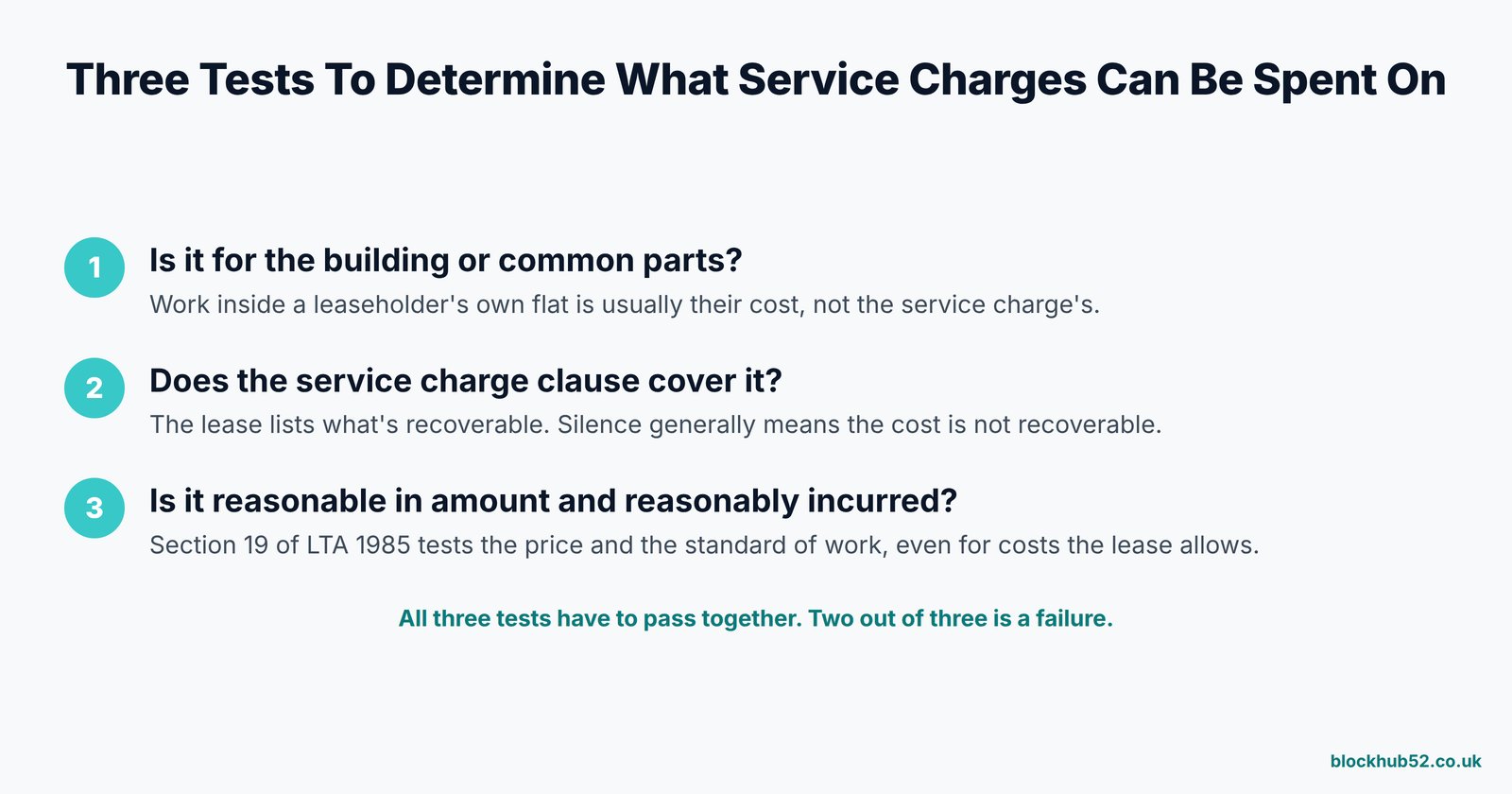
Service charges can be spent on a cost where the cost is for the building rather than a private flat, the lease covers the cost, and the cost is reasonable. All three tests have to be satisfied together. Passing two out of three is a failure.
Test one: is the cost for the building or the common parts?
Service charge money is contributed by all leaseholders for the shared parts of the building. Work inside one leaseholder's own flat, inside the area demised to that leaseholder, is usually that leaseholder's own responsibility. Some leases keep structural elements inside a flat as the company's responsibility, so read rather than assume.
The boundary is defined in the lease, usually in the parcels clause and the plan, and the boundary is not always where instinct suggests. Windows, front doors, balconies and internal partition walls all vary.
Test two: does the service charge clause actually cover the cost?
Leases list what the company must do and what the company may recover. Read the covenant wording closely.
- A clause covering "repair, maintain and renew" is doing different work from a clause covering "repair, maintain, renew and improve".
- A clause listing specific services may or may not end with a sweeper provision allowing other costs of good management. Sweeper clauses are common and they matter.
- Where the wording is genuinely silent on a category of cost, silence generally means the cost is not recoverable.
Test three: is the cost reasonable in amount and reasonably incurred?
Section 19 of LTA 1985 limits recovery to costs reasonably incurred, and to work carried out to a reasonable standard. A cost can be perfectly within the lease and still be reduced by a tribunal because the price was too high, because no comparison quotes were obtained, or because the work was poor.
Section 19 of LTA 1985 is the reason a paper trail of quotes matters even for routine jobs.
And then the procedural conditions. Passing all three tests is necessary but not sufficient.
Consultation under section 20 of LTA 1985, the eighteen-month time limit in section 20B of LTA 1985, the summary of rights required by section 21B of LTA 1985, and the landlord name and address requirements in sections 47 and 48 of the Landlord and Tenant Act 1987 (LTA 1987) all affect whether a recoverable cost can actually be collected.
What Service Charges Can Typically Be Spent On
Most leases cover the ordinary costs of running and maintaining the shared parts of a residential block. The list below is what leases commonly permit, and every item is still subject to your own wording.
- Repairs and maintenance of the structure and common parts. Roofs, external walls, gutters, drains, communal staircases, entrance halls, external decoration. The core category, and the one most leases cover in the widest terms.
- Buildings insurance. Nearly every lease requires the company to insure the building and permits recovery of the premium. Leaseholders have a statutory right to see the policy details, so keep the schedule and the certificate to hand.
- Cleaning and gardening of common areas. Regular communal cleaning, window cleaning of common parts, grounds maintenance and communal bin areas.
- Communal lighting, power and water. Electricity for hallways, stairwells, external lighting and any communal supply. Individual flat supplies are not part of the service charge.
- Lift maintenance, inspection and insurance. Servicing contracts, statutory thorough examinations and lift repairs, where the building has a lift.
- Fire safety and statutory compliance work, where the wording is wide enough. Fire risk assessments, alarm and emergency lighting servicing, extinguisher maintenance, asbestos surveys and remedial work. Worth checking rather than assuming, because some older leases predate modern compliance duties and do not obviously cover them.
- Managing agent fees, where an agent is appointed. Recoverable where the lease permits management costs, which most do. Fees still have to be reasonable in amount.
- Accountancy and service charge certification fees. Preparation and certification of the annual service charge accounts, where the lease provides for the cost. Some leases specify a certificate by a particular type of professional.
- Reserve fund contributions, where the lease allows. Check what your lease actually says, because there are four possible positions: some leases require a fund, some permit one, some say nothing, and a few prohibit collecting in advance. Read the wording carefully before deciding there's no power, because some leases allow it without ever using the words "reserve fund" or "sinking fund".
What Service Charges Cannot Be Spent On
Service charges cannot cover costs that fall outside the lease, whatever the reason for incurring them. Charges outside the lease are not payable by leaseholders, and the shortfall lands on the company instead.
- Work inside a leaseholder's demised property. A leaking pipe serving one flat only, internal redecoration, a faulty boiler inside a flat. The lease defines the boundary, and work on the leaseholder's side of it is usually at their own cost.
- Anything the lease does not mention, or expressly excludes. Where a lease lists services and the list does not include a category, the omission usually means the cost is not recoverable. Check for a sweeper clause before deciding, though, because wording like "all other costs of good management" can catch things the list does not name. Some leases go further and exclude categories outright.
- Improvements, where only repair is permitted. Covered in full in the next section, because improvements cause more disputes than every other category combined.
- Costs arising from the company's own negligence or breach. Recovery may be open to challenge, particularly where the expense arose because the company failed to carry out an obligation the lease required. If the lease obliged the company to keep the gutters clear, nobody did for six years, and water damage rotted the timbers below, a leaseholder may argue the timber repair only became necessary because the company neglected its own duty.
- Litigation costs, in many circumstances. Some leases permit recovery of legal costs and some do not. Even where recovery is permitted, a tribunal can order under section 20C of LTA 1985 that the costs of proceedings are not added to the service charge. Costs of disputes between individual occupiers are rarely recoverable at all.
- RTM Company administration costs, unless the lease allows. Companies House filing fees, confirmation statements, company accounts, directors' and officers' insurance and company secretarial work are costs of running the company, not of managing the building. The RICS Code, 4th edition, is explicit that company administration costs may not be recoverable as service charges under the lease. RTM Company money and service charge money are legally different things, and the distinction is worth keeping visible in the accounts.
- Costs demanded too late. Under section 20B of LTA 1985, a cost incurred more than eighteen months before the demand is generally not recoverable, unless leaseholders were notified in writing within the eighteen months that the cost had been incurred and would be charged.
- Costs above the consultation limits, where consultation was skipped. Where section 20 of LTA 1985 applies and was not followed properly, recovery is capped at £250 per leaseholder for qualifying works, and £100 per leaseholder per year under a qualifying long-term agreement. The First-tier Tribunal (FTT) can grant dispensation, but dispensation has to be applied for.
Is It a Repair or an Improvement?
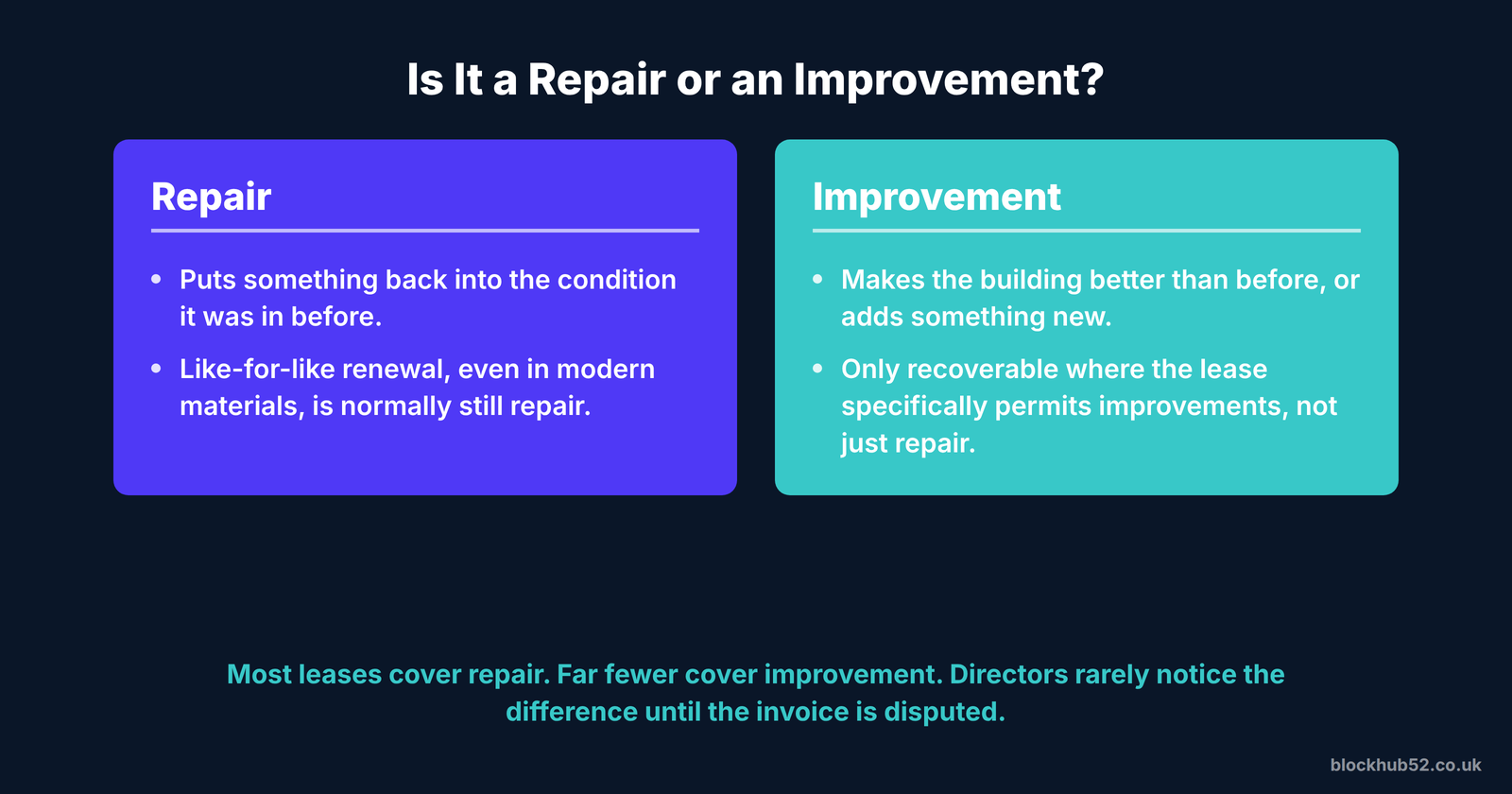
A repair puts something back into the condition the thing was previously in. An improvement makes the building better than before, or adds something that was not there at all.
Most leases oblige the company to repair, maintain and renew, and permit recovery of the cost of doing so. Far fewer permit recovery of the cost of improvements. That is why the line matters, and directors rarely notice the word "improvement" in the clause.
The classic example: replacing a rotten timber window with a new timber window of the same specification is repair. Replacing the same window with a double glazed unit in a different material starts to look like an improvement, and there is long-standing case law on exactly that point. Directors reach for the better option in good faith, then discover the better option was not chargeable.
Two refinements are worth knowing:
- Renewal using modern materials can still be repair. Where the original specification is obsolete, and the modern equivalent is the cost-effective way to put the defect right, courts have accepted the work as repair. The question is whether the work is a sensible way to remedy an existing defect, not whether the finished result is better than the original.
- Discretionary work is scrutinised harder. Where a company chooses to carry out work going beyond putting a defect right, appeal-level authority indicates the FTT will look more closely at whether the decision was reasonable, including whether the directors considered the views of leaseholders and the financial impact on them.
One trap to name directly. The word "improvements" appears in statute in two places that mislead directors. The definition of a service charge in section 18 of LTA 1985 mentions improvements, and the definition of "qualifying works" for section 20 of LTA 1985 consultation includes them. Neither creates a right to recover the cost of improvements. Both describe what the statutory protections apply to, not what the lease permits. So a director can run the consultation perfectly, keep every notice and every quote, and still find the cost is not chargeable because the lease never allowed improvements in the first place.
What Happens If a Director Gets It Wrong?
A leaseholder can apply to the First-tier Tribunal (Property Chamber) under section 27A of LTA 1985 for a determination of whether a service charge is payable, either before or after the charge has been paid. The tribunal can decide a cost is not recoverable, in whole or in part. In practice it often finds for the company, particularly where the lease clearly covers the cost and the board can show how the decision was made. Being challenged is not the same as being in trouble.
What follows from that:
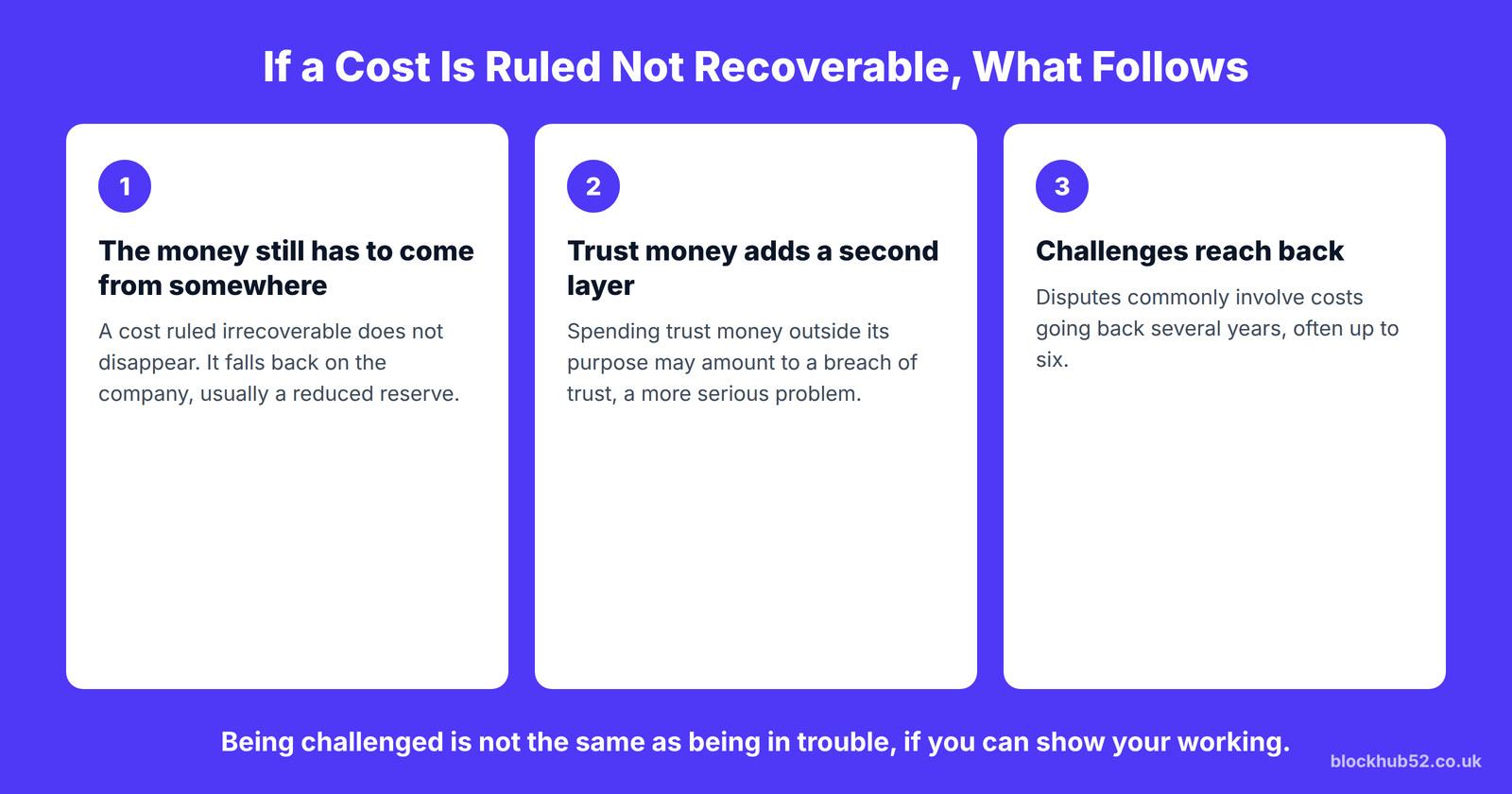
- The money still has to come from somewhere. A cost ruled irrecoverable does not disappear. The cost falls back on the company, which for a small self-managing block usually means a reduced reserve, another route to the same leaseholders, or a shortfall the company has no obvious means of funding.
- Trust money adds a second layer. Service charge contributions are held on statutory trust under section 42 of LTA 1987. Money held on trust for a defined purpose and spent outside that purpose may amount to a breach of trust, which is a different and more serious problem than a disputed invoice.
- Challenges reach back. In practice, service charge disputes commonly involve costs going back several years, often up to six. Being able to produce the invoice, the quotes, the clause relied on and the decision reasoning, quickly, several years later, is the difference between a short exchange and a long one.
Does the Tribunal Always Enforce This?
No, and directors should understand why, because the gap between the rule and the outcome shapes what actually protects a board.
The rule is strict. Lease wording often is not. Many leases contain wide sweeper clauses, so costs that look outrageous frequently turn out to be within the lease.
"Reasonably incurred" under section 19 of LTA 1985 also tests the decision-making process more than the price. A landlord who obtained quotes and can explain the choice generally passes, even where a cheaper contractor existed. Tribunals are reluctant to substitute their own commercial judgement.
Two further realities. The FTT decides on the evidence put in front of it, and leaseholders often arrive with a sense of grievance rather than comparative evidence.
And since the Supreme Court decision in Daejan Investments Ltd v Benson, dispensation from consultation failures is usually granted unless leaseholders can show they suffered real prejudice. The £250 cap is far harder to land than it once was.
There is a gap between what the rule says and what tribunals actually decide. Documentation is what closes it.
What this means for you as a director is simple. The tribunal rewards documented process over good intentions. A director who can show the clause relied on, the quotes obtained and the reason for the decision is in a materially stronger position than one who acted just as reasonably and wrote nothing down.
What Should You Check Before Instructing Anyone?
Check the lease before you look for a contractor, not before you pay the invoice. By the time an invoice arrives the work has usually been done, the company is committed, and any consultation that should have happened has already been missed.
The sequence that works:
- Read the lease first. Find the service charge clause, read the actual words, and note the clause reference. Do this before requesting quotes.
- Decide which side of the boundary the work sits on. Common parts and structure, or inside somebody's flat.
- Check whether the work is repair or something more. If the answer is "more", check whether improvements are permitted before going any further.
- Check the thresholds before the work starts. Would any single leaseholder pay more than £250 towards the work, or more than £100 in a year under a contract lasting more than twelve months? Both figures include VAT, and both are measured against the flat paying the largest share, not an average across the block. If either is exceeded, consultation under section 20 of LTA 1985 has to be completed before the work begins.
- Then get quotes. Comparative quotes are the evidence that the cost was reasonably incurred.
- Write down the reasoning at the time. The single highest-value habit on this list. One short note recording the clause relied on, the quotes obtained and why the chosen contractor was chosen. Reconstructing reasoning three years later is far harder than recording it on the day.
- Keep company costs separate from service charge costs. Filing fees, company insurance and company accounts belong in company records unless the lease clearly says otherwise.
Reform is coming in this area. Provisions of the Leasehold and Freehold Reform Act 2024 dealing with service charge transparency and litigation costs have not yet been brought into force, at the writing of this article, and government consultations were still running during 2026. So make sure to stick to the law currently in force and keep an eye on any updates.
Frequently Asked Questions
Can service charges pay for repairs inside my own flat?
Usually not. Service charge money covers the building and the common parts, not the property demised to an individual leaseholder. The lease defines the boundary, and repairs on the leaseholder's side of it are normally the leaseholder's own cost. Check the parcels clause, because boundaries for windows, doors and balconies vary, and some leases keep structural elements inside a flat as the company's responsibility.
Can service charges be used to build up a reserve fund?
It depends on what your lease says, and there are four possible answers. Some leases require a fund to be maintained, and running the block without one may breach the lease. Some permit a fund without requiring it, which leaves the decision to the board. Some say nothing at all. A few expressly prohibit collecting in advance. Read the wording carefully before deciding you are in the silent box, because some leases allow money to be held back for later years without ever using the words "reserve fund" or "sinking fund".
Can service charges pay the RTM company's "Companies House fees" and directors' insurance?
Often not. Costs of running the company, including filing fees, confirmation statements, company accounts and directors' and officers' insurance, are company administration costs rather than costs of managing the building. The RICS Code, 4th edition, states that company administration costs may not be recoverable as service charges under the lease. Read the lease, and where it is silent, fund company costs from company money.
What is the difference between a repair and an improvement?
A repair restores something to its previous condition. An improvement makes the building better than before or adds something new. Like-for-like renewal is normally repair, and using modern materials does not automatically turn a repair into improvement where the modern equivalent is the sensible remedy. Genuine upgrades, such as installing an entry system where none existed, are usually improvements and are only recoverable where improvements are specifically permitted.
Can service charges pay our legal costs if a leaseholder takes us to tribunal?
Sometimes, and the answer depends on the lease. Some leases permit recovery of legal and professional costs through the service charge and some do not. Even where recovery is permitted, a leaseholder can apply under section 20C of LTA 1985 for an order that the costs of the proceedings are not added to the service charge, and tribunals do make such orders. Legal costs should never be assumed to be recoverable.
Do we have to consult leaseholders before spending?
Consultation under section 20 of LTA 1985 is required where any single leaseholder would contribute more than £250 towards qualifying works, or more than £100 in a year under a qualifying long-term agreement lasting more than twelve months. Both figures include VAT, and both are tested against the flat paying the largest share. Without proper consultation, recovery is capped at those figures regardless of the actual cost. Urgency is not an exception, although the FTT can grant dispensation on application.
What happens if we charge something the lease does not cover?
A leaseholder can apply to the FTT under section 27A of LTA 1985 for a determination that the charge is not payable. Where the FTT agrees, the cost falls back on the company rather than on leaseholders. Because service charge money is held on trust under section 42 of LTA 1987, spending trust money outside the permitted purpose may also amount to a breach of trust.
Where to Start
Three years from now, someone will ask why you charged for that job. BlockHub52 keeps every invoice, quote and decision note in one place, so the answer takes seconds.
- Free UK Block Compliance Wall Chart. The most important statutory deadlines in one page.
- Book a free call about your building. If BlockHub52 is a fit, you get 45 days free to try it.
Related Reading
BlockHub52 provides general information only. Nothing here is legal or financial advice. Always take independent qualified advice for your own situation.